Preventative HVAC Care Is Risk Management for a Commercial Building
An HVAC program is less about the equipment than about what a failure would cost you on the worst possible day.
October 16, 2026 · 3 min read
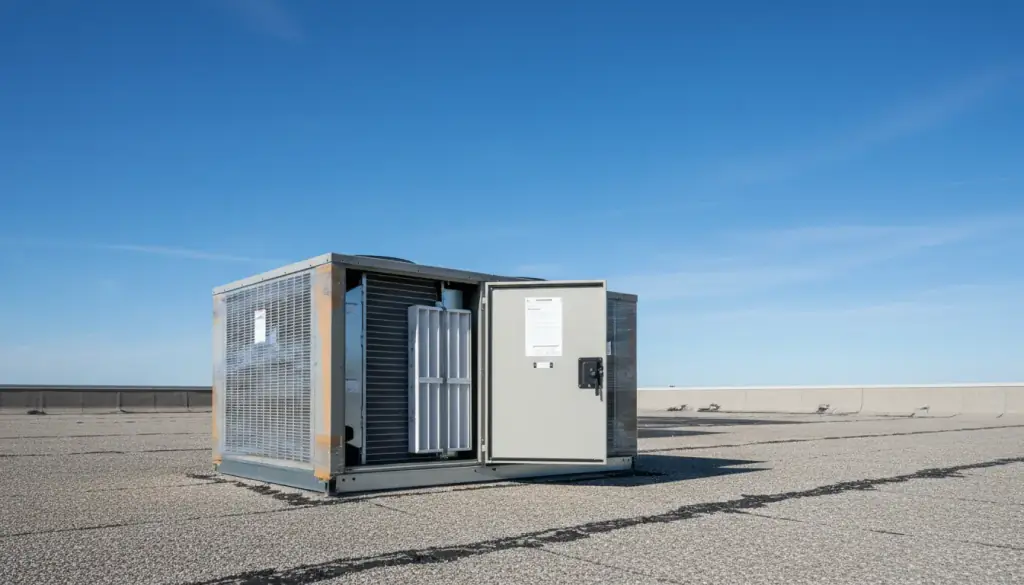
Most HVAC failures in commercial buildings do not arrive on a mild afternoon. They arrive on the hottest day of the summer or the coldest morning of the winter, when the system is working hardest and every vendor in town is already booked. The unit that quits in July was usually showing signs in April. Nobody was looking, or somebody was looking and nobody wrote it down.
That is why preventative HVAC care is better understood as risk management than as maintenance. The point is not to keep equipment pretty. The point is to lower the odds that a tenant, an employee, or a customer ends up in an uncomfortable building, and that you end up on an emergency call with limited options.
Filters and airflow do most of the heavy lifting
The least glamorous tasks prevent the most calls. A clogged filter forces a blower to work against resistance, restricts airflow across the coil, and can lead to freezing, overheating, or a long list of comfort complaints that look like unrelated problems. Replacing filters on a set schedule and checking airflow across a building, not just at the unit, catches many issues before anyone feels them.
Airflow and temperature inconsistencies are also a diagnostic signal. If one corner of the building runs warm every afternoon, that is rarely bad luck. It may be a damper, a control setting, a blocked return, or a unit that is no longer keeping up. A performance check that compares what the system is doing against what it should be doing turns a vague complaint into something a technician can act on.
Controls deserve a mention here as well. A thermostat or controller set incorrectly, or a schedule that no longer matches how the building is used, can waste energy and generate complaints while the equipment itself is perfectly healthy. Checking settings against actual occupancy during a routine visit is quick, and it often resolves a complaint that three service calls could not.
Seasonal readiness is a scheduled event, not a hope
Systems that sit through a mild stretch tend to be tested for the first time on the first extreme day. A seasonal readiness assessment before the cooling season and again before the heating season changes that. It is a deliberate look at whether the equipment starts, runs, and holds its setpoints before the building depends on it.
Timing matters. A problem found in a shoulder season can be repaired on a normal schedule with parts ordered at a normal pace. The same problem found during a heat wave becomes an emergency, with the cost, disruption, and stress that come with one. Preventative servicing exists to move failures out of the second category and into the first.
Documentation turns service into a record
The third piece is the one managers skip most often. Documentation and service tracking are what let you see patterns instead of isolated events. A short record for each unit makes the next decision easier.
- What was inspected, what was found, and what was done on each visit.
- Filter change dates and the type of filter installed.
- Repeat complaints tied to a location, so you can see whether it is one zone or the whole system.
- Photos of equipment condition, nameplates, and any visible wear.
- Recommendations that were deferred, and the reason they were deferred.
With those records in hand, replacement planning stops being a guess. You can show an owner that a unit has needed repeated service, rather than arguing from impressions. You can also see when a repair is a one-off and when it is the third visit for the same symptom, which is usually the moment to talk about replacement.
When something still fails
No program removes every failure. Heating and cooling system failures, control issues, and equipment malfunctions will still happen, and they tend to happen at inconvenient times. What preventative care changes is the starting position. You already know the equipment's history, you have a single contact who understands the building, and the conversation begins with facts instead of a blank page.
Resolute Facilities Solutions supports commercial buildings with HVAC inspections, performance checks, filter and airflow work, seasonal readiness assessments, and repairs, coordinating with qualified HVAC providers and keeping the service documentation in one place. Emergency calls are taken around the clock at 833-588-5286 by call or text. If you want a program sized to your building, ask for a free estimate through the contact page.
Resolute Facilities Solutions, 833-588-5286
Call 833-588-5286More articles
Quarterly or Semiannual Facility Inspections: How to Choose a Cadence
The right inspection schedule depends on how hard the building works, and the findings only matter if someone sorts them.
What One Point of Contact Changes When You Manage a Building Full of Vendors
Fewer phone numbers is the visible change; fewer gaps between trades is the one that saves you.